
Document control:
Document control information
Policy name: Policy for the development, ratification and implementation of policies
Policy number: C001
Version: 1.0
Status: Final – Approved
Author / lead: Sara O’Connor, Senior Manager Corporate Services
Responsible Executive Director: The Chief Executive has delegated responsibility to the Executive Director of Corporate Services for the management of policies
Responsible Committee: Executive Committee and Essex Joint Committee
Date ratified by Responsible Committee: 6 January 2026 and 22 January 2026
Date approved by Board: 1 April 2026
Next review date: April 2028
Target audience: All ICB Board members and staff (including temporary/bank/agency/work experience staff, students and volunteers)
Stakeholders engaged in development of policy (internal and external):
– Governance Team
– Executive Committee
– Audit Committee
Impact assessments undertaken:
– Equality and Health Inequalities Impact Assessment – completed
– Quality Impact Assessment – N/A
– Privacy Impact Assessment – N/A
Version history:
Version: 0.1
Date: 06/01/26
Author (Name and title): Senior Manager Corp Svcs
Summary of amendments made: Draft Policy
Version: 1.0
Date: 19/01/26
Author (Name and title): Corp Svcs & Gov Support Officer
Summary of amendments made: Final – Approved version
Introduction
To ensure robust governance, organisations need formal written documents, such as policies, which communicate standard corporate organisational ways of working. These help to clarify current legislation, guidelines and best practice, strategic and operational requirements and ensure consistency within day-to-day practice. In addition, they can improve the quality of work, increase the successful achievement of objectives and support patient safety, quality and experience. All policies will undergo an Equality Impact Assessment (Appendix A) and website accessibility checks to support the ICB’s equality, diversity and inclusion agenda. It is recognised that systems need to be in place to ensure policies are user friendly, up-to-date and easily accessible.
A common format and approval structure for policies will reinforce corporate identity. More importantly, this will help to ensure that policies and related procedures in use are current and reflect an organisational approach. It will also avoid confusion and assist employees to readily access information within the document in a consistent manner.
This is a controlled document. Whilst this document may be printed (please consider if this is necessary) the electronic version posted on the intranet is the controlled copy. Any printed copies of this document are not controlled. As a controlled document, this document should not be saved onto local or network drives but should always be accessed from the website (or requested from the Governance Lead/Team) to ensure the most up-to-date version is used.
Purpose
Essex Integrated Care Board (the ICB) intends that its organisational policies should provide a clear understanding of what is expected of employees and Board members.
Whilst this document is particularly relevant to staff who are responsible for writing or reviewing policies, it is equally important that all Board members and employees understand the relevance of having these in place.
Occasionally policies will be developed through partnership working and may have a different format than that described here. In these instances, the policy itself will be adopted but will still be quality-assured against the criteria of this document to ensure that when presented for final approval it meets the ICB’s requirements.
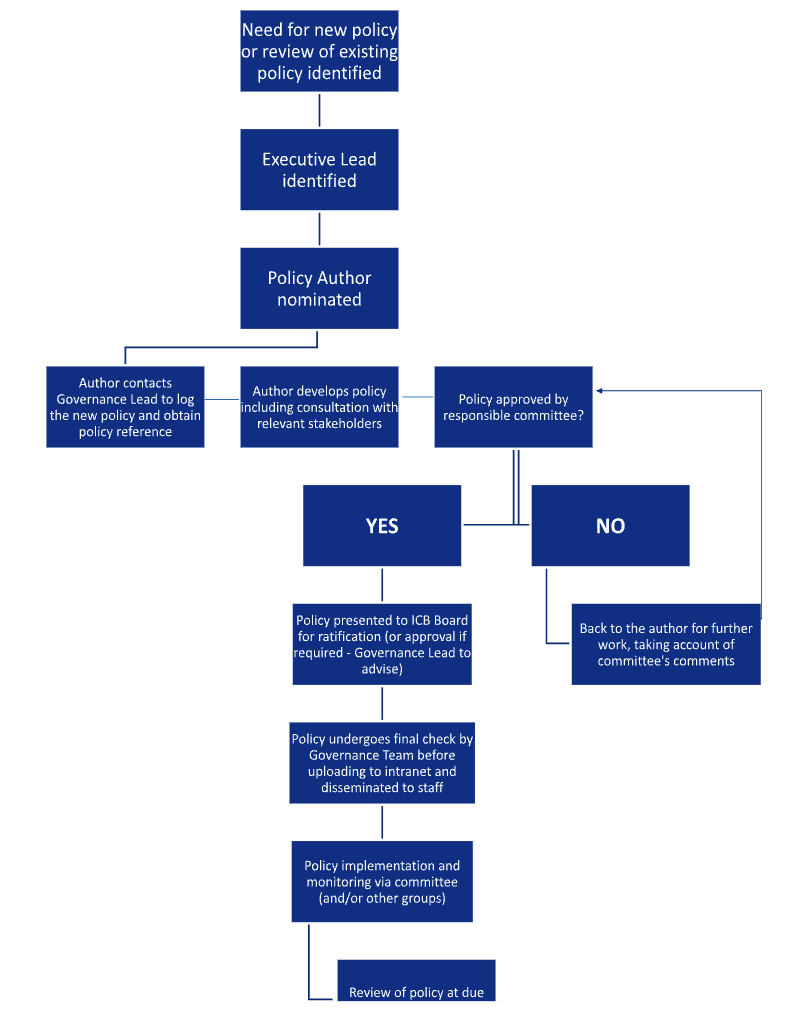
This document outlines the process for policy development from inception through to ratification, implementation and evaluation.
A flow chart detailing this process is shown at Appendix B.
Scope
This policy applies to all ICB Board members and staff (including temporary/bank/agency/work experience staff, students and volunteers).
Definitions
- Policy – an organisation wide corporate policy is a ratified plan of action which applies to all relevant staff as a ‘must do’ requirement. The formal policy document is legally binding between employer and employee. A policy says ‘what you must know or do.’
- Procedure – an organisation wide procedure is a standardised series of actions taken to achieve a task in an agreed and consistent manner to attain a safe and effective outcome. A procedure is a formal document that must be complied with as it may be used to support an individual or the ICB during legal action. A procedure tells you ‘how it must be done.’
- Strategy – a strategy is a document that defines a process of moving towards an ideal situation, generally over the long-term, implementing actions or compliance with a policy. A strategy tells you ‘how we will get from A to B.’
Roles and responsibilities
Integrated Care Board
The ICB Board has overall responsibility for ensuring that the organisation has a robust system in place for the development, approval and regular review of policies covering all corporate activities.
The ICB Board will receive formal confirmation from the committee sponsoring the policy that it meets the requirements of the Policy for Policies and has been approved by the committee via regular policy updates at Board meetings. The ICB Board is responsible for providing formal approval of all new ICB policies and those which have been subject to substantial or significant revisions, having received this assurance.
Committees
The responsibility of the ICB’s main committees is to review and approve policies that are new or have been subject to substantial or significant revisions since the previous version.
NB: Minor amendments that do not change the intention of a policy, e.g. typographical errors, can be made by policy authors/governance team and noted in the version control table.
Responsibility for policies is set out in committee terms of reference and summarised below:
Committee
Audit, Risk and Compliance Committee
Policy responsibility
- Standards of Business Conduct/Conflicts of Interest/Fraud, Bribery & Corruption
- Health & Safety
- Information Technology/Digital
- Information Governance
- Emergency Planning/Business Continuity/Security
- Corporate communications (media/social media)
Committee
Chief Executive
The Chief Executive Officer of the ICB has overall accountability for implementing the Policy for Policies.
Executive Director of Corporate Services
The Chief Executive has delegated operational responsibility for implementation of this policy to the Executive Director of Corporate Services.
Policy authors
Policy authors are responsible for reviewing and updating the policies within their remit on an annual basis or should legislation, guidance, organisational change or other circumstances necessitate an earlier review.
Governance lead
The Associate Director of Governance supported by the Governance and Risk Manager (referred to in this policy as the Governance Lead) will provide support with policy development by:
- Offering support and advice to policy authors.
- Testing the rationale for the need for an ICB policy.
- Logging the policy on the relevant policy register.
- Identifying possible overlap/conflict with any other policies that have been ratified or are in development.
- Identifying whether the document is a policy or a local procedure or guidance.
- Identifying and confirming the correct ratification route.
- Confirming that a draft policy meets the requirements of the Policy Development Checklist (Appendix C) before it is submitted to the ratifying committee.
- Liaising with the Communications and Engagement Team to upload ratified policies to the intranet and internet.
- Maintaining the register of active policies.
- Archiving old policies.
- Advising policy leads when policies are due for review.
Line managers
Line Managers are responsible for:
- Identifying when a new or amended policy may be required for business areas within their remit.
- Ensuring that new members of staff are made aware of key policies as part of their induction.
- Highlighting new and amended policies within their team briefings.
- Monitoring the implementation of policies within their team, by identifying risks and key performance indicators to indicate/measure the effectiveness or a policy, auditing compliance and addressing any failures to follow agreed processes.
All staff
All staff need to ensure they are aware of the system for policy development, ratification and implementation. This includes a requirement on receipt of new policies to review their contents and assess the relevance to their role.
All staff should be aware that wilful or negligent disregard of any policy will be investigated and potentially treated as a disciplinary offence.
Policy detail
Style and format
All policies and any related procedures should be developed using the Policy Template appended to this policy (Appendix D). Requirements in respect of style and format are detailed on the template itself.
The Policy Template has been designed to be accessible in accordance with the requirements of the Equality Act 2010 and the Public Sector Bodies (Websites and Mobile Applications) Accessibility Regulations 2018. The Equality and Human Rights Commission is responsible for enforcing the regulations. It is imperative, therefore, that policy authors use the template provided and do not attempt to modify its format. Accessibility checks must be performed by the policy author and any issues addressed prior to approval of a new or revised policy.
Key features of a well-written policy
Each policy must be compliant with all current legal and statutory requirements that are relevant to their development. A well written policy should:
- Be clear, concise, jargon free and written in straightforward language, with flowcharts or diagrams where these aid understanding
- Explain abbreviations or acronym the first time they are used.
- Take account of the relevant views of stakeholders where appropriate.
- Be sound / evidence based.
- Have clear objectives.
- Specify how it will be implemented, monitored and audited.
- Describe a consequence of any breaches.
Development of new and revised policies
It is important that the development of policies and related procedures are linked to service priorities and that they do not duplicate other work either nationally or locally. Therefore, the author must ensure that they have researched the background and available evidence prior to consultation and ratification.
An author may be requested to develop a new policy based on ICB needs, changes in legislation or national requirements.
An author who is reviewing an existing policy is expected to review the contents of the current version for their continued relevance and maintaining continuity between versions. The author will also be responsible for checking that any hyperlinks remain valid and undertaking a new Equality Impact Assessment which must be included in each policy as an Appendix
Whilst writing the policy, the author should use the Policy Development Checklist (Appendix C) to confirm whether it meets necessary requirements.
Consultation
Consultation should be undertaken to secure the support and experience from all relevant individuals and groups, for example Staff Side (unions) for HR policies. Advice on consulting with Staff Side can be obtained from the ICB’s Human Resources Lead.
It is vital to the success of the implementation of any policy that the expertise and experience of all relevant parties has been considered, particularly those who will be expected to implement its requirements.
The consultation process is an opportunity to influence the policy content and should not be considered only as an exercise to satisfy the checklist requirements.
A draft policy when sent out to stakeholders should be as near to the ‘final’ draft version as possible and include all relevant references with details of associated documentation. This will help to ensure that the stakeholders are able to review and make appropriately informed comments. Sufficient time should be given to enable a thorough review by stakeholders.
A list of all staff and stakeholders consulted during the policy development should be included in the relevant section.
Preparation for approval
Once the policy has been fully consulted upon and comments considered, it is ready for formal agreement and ratification.
It is the author’s responsibility to contact the Governance Lead to request that the policy be added to the agenda of the next appropriate committee meeting, although the governance team will track and remind policy authors when policies are due for review.
The author should submit the draft policy, completed Policy Development Checklist and a summary of the purpose of the policy (if new) or of the key changes that have been to the existing policy (if amended) to the Governance Lead/Team.
The Governance Lead/Team will review the policy and associated documents and advise the policy author if any changes or additional information is needed before it is submitted to the ratifying committee.
The policy author may be invited to attend the committee meeting to present the policy and respond to any queries.
If the policy is not deemed to be ready for formal ratification, the committee will agree with the author where amendment or clarification is required. The author will then re-submit to the next meeting if appropriate. If the policy is deemed ready for final approval (with or without minor amendments), then it will be approved by the relevant committee(s) and ratified by the ICB Board, or, in the case of new or significantly amended policies, approved by the ICB Board.
Fastrack policy approval process
There will be occasions due to urgency or immediacy where the process of formal ratification needs to be accelerated, but this should be on an exceptional basis only. In these circumstances, committee Terms of Reference allow for urgent decisions to be taken outside of their normal meeting schedule. If necessary, the policy can then be formally approved by the ICB Board under the exercise of Emergency Powers.
Dissemination and communication to staff and the public
The Governance Team will liaise with the Communications and Engagement Team to arrange for all ratified policies to be added to the staff intranet and external website in accessible HTML format, and staff will be notified of all policy activity through the ICB’s internal communication system.
Policies must be provided in alternative formats upon request, such as larger print, easy read, braille, audio format and different languages.
Document control including archiving arrangements
The Governance team will hold a central register of all current policy documents, together with a master file of electronic copies, including archived documents.
Monitoring compliance
Performance indicators will be used to monitor effectiveness of this and other policies. These may include compliance with associated mandatory training, the RAG rating of associated risks, complaints, claims and incidents and the outcome of audits to identify where failure to follow policy may have impacted on commissioning, service delivery, regulatory compliance or corporate governance.
The monitoring compliance section of each policy should identify the intelligent data sources (where available) that should be reported to the sponsoring committee that indicate whether or not the policy is being adhered to / delivered. These will form part of the intelligent Board reports from the sponsoring committee to the ICB Board.
The relevant sponsoring committee will be responsible for ensuring that policies submitted to them for approval are compliant with this policy.
Implementation and staff training
There is a requirement as part of local induction to ensure that staff are made aware of the importance of policies and procedures and their adherence to them.
All policies must identify training requirements associated with them and the frequency with which this training is required. Policy authors should contact Human Resources for any e-Learning available via ESR relevant to the policy.
Arrangements for review
This policy will be reviewed no less frequently than every two years. An earlier review will be carried out in the event of any relevant changes in legislation, national or local policy/guidance, organisational change or other circumstances which mean the policy needs to be reviewed.
If only minor changes are required, the sponsoring committee has authority to make these changes without referral to the ICB Board. If more significant or substantial changes are required, the policy may need to be ratified by the relevant committee before final approval by the ICB Board. The Governance Lead will provide advice on the correct approval route if required.
Associated policies, guidance and documents
The author is required to provide details of supporting or linked strategy, policy, procedural or other documents within the ICB that may need to be read in conjunction with the policy or for staff to be aware of their existence.
For this policy the associated documentation is:
- Policy Template.
- Policy Checklist.
Associated policies
This policy is relevant to all ICB Policies.
References
The author should provide references to any documents that have been used to develop the policy as evidence that it has been based on best practice and guidance.
For this policy the references are:
- Equality Act 2010.
- Public Sector Bodies (Websites and Mobile Applications) (No. 2) Accessibility Regulations 2018.
Equality impact assessment
An Equality Impact Assessment (EIA) of this policy has been undertaken and it has identified no equality issues.
The EIA has been included as Appendix A.
Appendix A – Equality impact assessment
Initial information
Name of policy: Policy for Policies
Version number (if relevant): 1.0
Directorate/Service: CEO’s office / Governance
Assessor’s Name and Job Title: Sara O’Connor, Senior Manager Corporate Services
Date: 17/12/2025
Outcomes
Evidence
Analysis if impact on equality
The Public Sector Equality Duty requires us to eliminate discrimination, advance equality of opportunity and foster good relations with protected groups. Consider how this policy / service will achieve these aims.
N.B. In some cases it is legal to treat people differently (objective justification).
- Positive outcome – the policy/service eliminates discrimination, advances equality of opportunity and fosters good relations with protected groups
- Negative outcome – protected group(s) could be disadvantaged or discriminated against
- Neutral outcome – there is no effect currently on protected groups
Please tick to show if outcome is likely to be positive, negative or neutral. Consider direct and indirect discrimination, harassment and victimisation.
| Protected group | Positive outcome | Negative outcome | Neutral outcome | Reason(s) for outcome |
|---|---|---|---|---|
| Age | X | No impact identified | ||
| Disability(Physical and Mental/Learning) | X | No impact identified. Policies will be made available in alternative formats on request. All final policies undergo website accessibility checks and will be uploaded to the ICB website in accessible HTML format. | ||
| Religion or belief | X | No impact identified | ||
| Sex (Gender) | X | No impact identified | ||
| Sexual Orientation | X | No impact identified | ||
| Transgender / Gender Reassignment | X | No impact identified | ||
| Race and ethnicity | X | No impact identified. Policies will be made available in alternative formats on request. | ||
| Pregnancy and maternity (including breastfeeding mothers) | X | No impact identified | ||
| Marriage or Civil Partnership | X | No impact identified |
Monitoring outcomes
Monitoring is an ongoing process to check outcomes. It is different from a formal review which takes place at pre-agreed intervals.
Review
Appendix B – Key stages of the policy process
Appendix C – Policy development checklist
| Criteria for Compliance | Author Yes/No | Author’s Comments | Reviewer’s Comments |
|---|---|---|---|
| Could this policy be incorporated within an existing policy? | If no explain why | ||
| If a new policy, has the Governance Team been notified so a policy reference can be allocated? | |||
| Does this policy follow the style and format of the agreed template? | |||
| Has the Document Control table been completed? | |||
| Has the Version Control table been completed? | |||
| Is there an appropriate review date? | Explain if less or more than 2 years | ||
| Have key performance indicators (or other arrangements) been identified to monitor effectiveness of the policy? | |||
| Have all relevant associated policies, references and hyperlinks been included and checked? | |||
| Have all appropriate stakeholders (including where necessary Staff Side, the Local Counter Fraud Specialist or Local Security Management Specialist) been consulted and identified on the stakeholder list? | |||
| Are all appendices referred to in the correct order, included within the policy (they must not be embedded) and their headings formatted correctly so they appear in the Contents list? | |||
| Has the Contents page been updated to show correct page numbers and hyperlinks to each section? | |||
| Has an Equality Impact Assessment (EIA) been undertaken/updated? (NB: The EIA is within the Policy template and should be included as Appendix A of the policy) | |||
| Has the policy been amended to address any negative impacts identified from the EIA? | |||
| Is a Quality Impact Assessment (QIA) or Privacy Impact Assessment required?NB: Seek advice from Quality Team or Information Governance Team if required. | |||
| Is there a clear indication of how the policy will be implemented? | |||
| Have job titles/responsibilities been updated to reflect the current ICB structure. | |||
| Has the ‘Footer’ of the policy been updated to reflect correct name, version and page numbers? | |||
| If the policy includes tables, flowcharts or diagrams, do these align with the content of the policy and meet website accessibility standards? | |||
| Has a website accessibility check been undertaken and any issues addressed? |
Appendix D – Policy template
[Insert Policy Name]
Policy No: EICB XXX
Document control
Document control information
Policy Name:
Policy Number:
Version:
Status:
Author / lead:
Responsible Executive Director:
Responsible Committee:
Date ratified by Responsible Committee:
Date approved by Board:
Next review date:
Target audience:
Stakeholders engaged in development of policy (internal and external):
Impact assessments undertaken:
Version history
Version:
Date:
Author (Name and title):
Summary of amendments made:
Contents
(Table of contents to be included)
Introduction
Insert text
This is a controlled document. Whilst this document may be printed (please consider if this is necessary), the electronic version posted on the intranet is the controlled copy. Any printed copies of this document are not controlled. As a controlled document, this document should not be saved onto local or network drives but should always be accessed from the website (or requested from the Governance Lead/Team) to ensure the most up-to-date version is used.
Purpose / Policy statement
Insert text Insert statement of policy
Insert narrative for bullet list:
- Bullet list (remove if not using)
Scope
E.g. This policy applies to all ICB Board members and staff (including temporary/bank/agency/work experience staff, students and volunteers).
Definitions
- State Word – Provide Definition
- State Word – Provide Definition
- State Word – Provide Definition
Roles and responsibilities
Integrated Care Board
Insert narrative for ICB Board responsibilities.
XXXX Committee
Insert narrative for Committee responsibilities.
XXXX Committee
Insert narrative for XXX Committee responsibilities (if applicable – repeat as necessary).
Chief Executive
Insert narrative for what the Chief Executive is accountable for.
Executive Director of XXX
Insert narrative for what the Executive Director lead is accountable for.
Policy authors
Insert narrative for what the Policy Authors are accountable for.
Governance lead
Insert narrative for what the Governance Lead is accountable for (if applicable).
Line managers
Insert narrative for what Line Managers are accountable for.
All staff
Insert narrative for what all staff are accountable for.
Policy detail
Subheading
Insert text. Additional headings can be added instead of subheadings if this aids comprehension.
Monitoring compliance
Insert text regarding KPIs or other data sources evidencing the policy is effective, such as associated risks and their RAG rating/scores, that will be used by committees or other groups to monitor compliance with the policy.
Insert text regarding the committees / groups responsible for monitoring compliance
Implementation and staff training
State how the policy will be implemented including mandatory or other training requirements. Contact Human Resources to check any e-Learning available via ESR.
Arrangements for review
This policy will be reviewed no less frequently than every two years [this may be reduced to one year if necessary, for example if required by a relevant standard, or extended to three years as long as this can be justified and explained within the policy]. An earlier review will be carried out in the event of any relevant changes in legislation, national or local policy/guidance, organisational change or other circumstances which mean the policy needs to be reviewed. Policy reviews should seek input from relevant stakeholders, including Staff Side/Staff Engagement Group for HR policies, and other appropriate fora including the Executive Team.
If only minor changes are required, the sponsoring Committee has authority to make these changes without referral to the Integrated Care Board. If more significant or substantial changes are required, the policy will be ratified by the relevant committee before final approval by the Integrated Care Board.
Associated Policies, Guidance and Documents
- List supplementary documents (if applicable)
Associated Policies (A hyperlink to the policies webpage will be added once the new EICB website goes live).
- List here the relevant associated ICB policies
References
- Provide a list of references of the documents that have informed or contributed to this policy.
Equality impact assessment
State either – the EIA has identified no equality issues with this policy OR Issues identified in the EIA were XXX and they have been addressed by XXX.
The EIA has been included as Appendix A.
Appendix A – Equality impact assessment
Initial information
Name of policy and version number:
Directorate/Service:
Assessor’s Name and Job Title:
Date:
Outcomes
Briefly describe the aim of the policy and state the intended outcomes for staff.
Evidence
What data / information have you used to assess how this policy might impact on protected groups?
Who have you consulted with to assess possible impact on protected groups? If you have not consulted other people, please explain why?
Analysis of impact on equality
The Public Sector Equality Duty requires us to eliminate discrimination, advance equality of opportunity and foster good relations with protected groups. Consider how this policy / service will achieve these aims.
N.B. In some cases it is legal to treat people differently (objective justification).
- Positive outcome – the policy/service eliminates discrimination, advances equality of opportunity and fosters good relations with protected groups
- Negative outcome – protected group(s) could be disadvantaged or discriminated against
- Neutral outcome – there is no effect currently on protected groups
Please tick to show if outcome is likely to be positive, negative or neutral. Consider direct and indirect discrimination, harassment and victimisation.
| Protected group | Positive outcome | Negative outcome | Neutral outcome | Reason(s) for outcome |
|---|---|---|---|---|
| Age | ||||
| Disability(Physical and Mental/Learning) | ||||
| Religion or belief | ||||
| Sex (Gender) | ||||
| Sexual Orientation | ||||
| Transgender / Gender Reassignment | ||||
| Race and ethnicity | ||||
| Pregnancy and maternity (including breastfeeding mothers) | ||||
| Marriage or Civil Partnership |
Monitoring outcomes
Monitoring is an ongoing process to check outcomes. It is different from a formal review which takes place at pre-agreed intervals.
What methods will you use to monitor outcomes on protected groups?
Review
Implementing the policy/service
Negative outcomes – action plan
If there are no negative outcomes, please remove this section.
An Equality Impact Assessment cannot be signed off until negative outcomes are addressed. What actions you have taken/plan to take to remove/reduce negative outcomes?
| Action taken/to be taken | Date | Person responsible |
|---|---|---|
If a negative outcome(s) remain explain why you think implementation is justified.
Insert response here.
Signed off by:
Date:
Appendix B – title XXX
Insert other appendices as appropriate – please use the same format as the heading above for each additional appendix.
To do this, click/highlight the above heading, then click on the ‘Format Painter’ icon (within the ‘Home’ menu tab), then highlight the new appendix heading). This ensures all appendix headings appear in the contents page.