
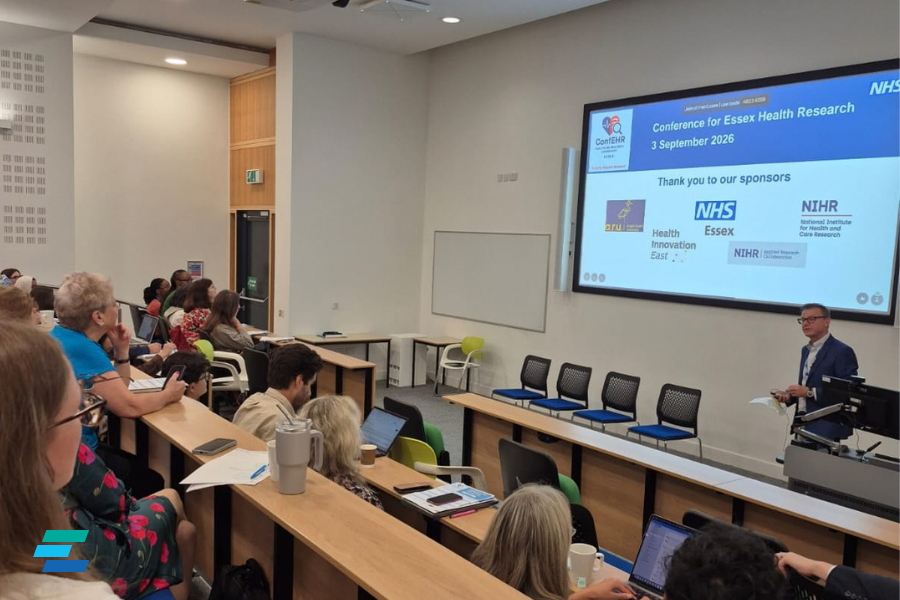
This month, the ICB brought together researchers, clinicians, partners and local people at our first Conference for Essex Health Research to find out how research in Essex can provide a health service ready for the future.
Dr James Hickling, Deputy Medical Director, explains why research is important, the work already happening in the county and the results of this work that are benefitting patients every day.
Research helps us find better ways to prevent illness, improve treatments and provide high-quality care. It also helps us understand what works best for patients and brings new ideas and innovations into everyday healthcare.
Here in Essex, we want to be at the forefront of these improvements so our patients can benefit from the innovations that are waiting around the corner. That is why we wanted to hold a Conference for Essex Health Research (ConfEHR 26), which we did in in early September at Anglia Ruskin University in Chelmsford. The conference brought together 100 people from the fields of medicine and academics and importantly, patients too.
During the conference we talked on a range of topics including how we can work together with different organisations and developing home-grown research that is designed by the people of Essex, for the people of Essex.
Research in action
Among our delegates was Dr Ankur Rahman, a vascular surgeon working at Mid and South Essex Foundation Trust in Basildon. He wanted to understand how to improve the flow of blood through his patients’ leg arteries. Supported by his Trust and Anglia Ruskin University, he has now secured funding for a trial and is a senior researcher the university. We have been able to support research into improving independence and reducing amputations while developing Dr Rahman’s research expertise in Essex.
Last year, we joined with Anglia Ruskin University to fund a dedicated research lead to support clinicians to develop research into ideas that could really benefit Essex patients. One of the projects to benefit from this is looking at how more women who may have been through trauma, can be encouraged to have their cervical screening.
Research for all communities in Essex
Connecting communities with research is just as important as the research itself. We want to hear from the people using services and receiving treatment and understand how research can help address inequalities too.
Inequalities often begin at the research stage, when people make assumptions about different populations, or may not understand people’s experiences. A lack of understanding can unintentionally exclude people from research opportunities.
Our Research Engagement Network (REN), which attended the conference, supports people from underserved communities get involved in health and care research opportunities like the ones we are working to grow.
It was positive to see researchers connecting with the REN group at the conference, looking particularly at making partnerships with young people who have first-hand experience of living with mental health. These partnerships will give academics the understanding, information and perspectives they will need to help shape research into that area of health and care.
We have a lot of positive contributions to work through after the first conference and are already thinking about ConfEHR 2027.
With thanks to all delegates and sponsorship from the National Institute of Health and Care Research (NIHR), Health Innovation East and Applied Research Collaboration East of England and Anglia Ruskin University